
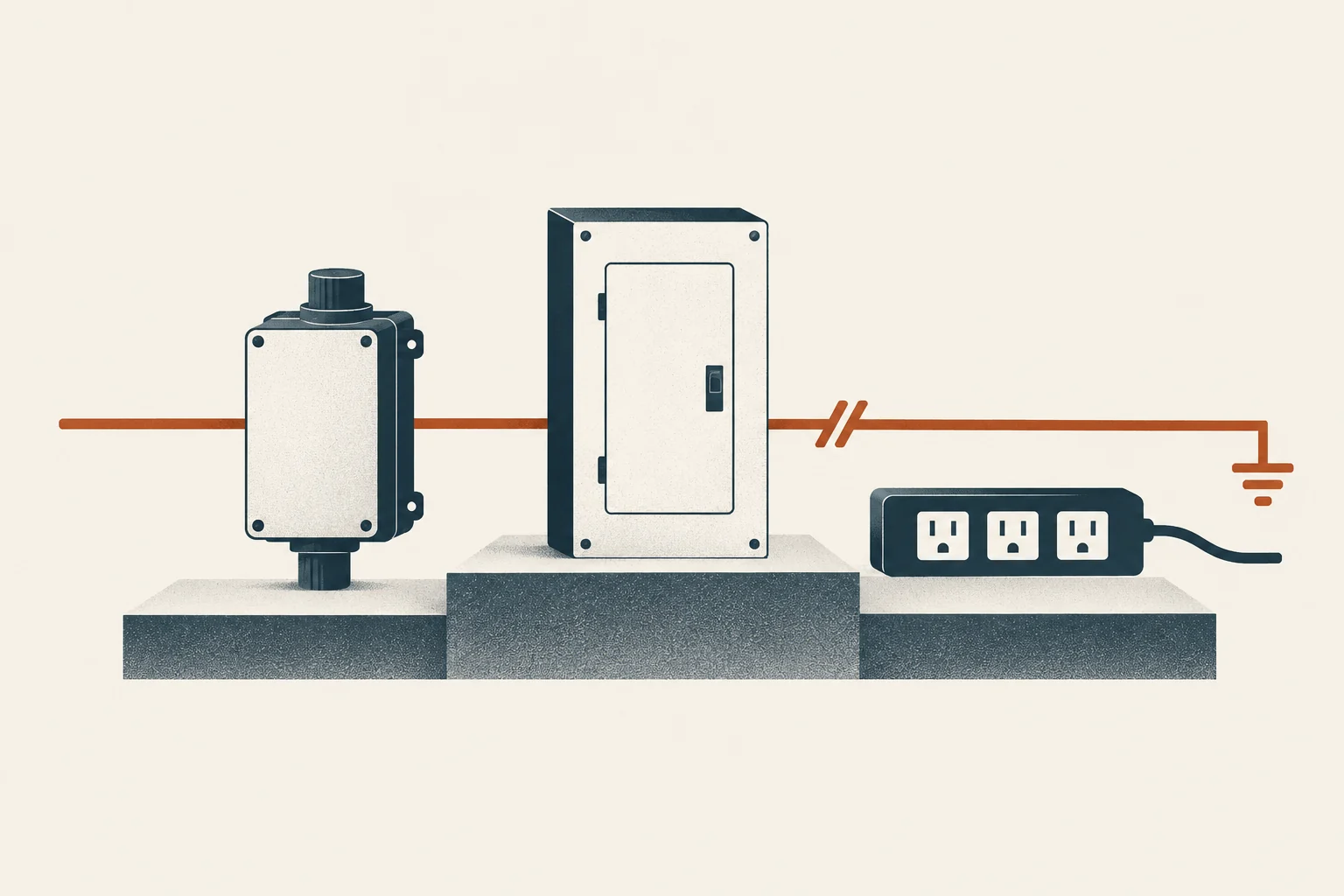
Type 1, Type 2, and Type 3 identify where a surge protective device is evaluated for use in the electrical system. They are not a best-better-good ranking. In a typical home, a Type 1 or Type 2 device can form the whole-home layer, while Type 3 devices add protection near selected loads.
The right choice depends on the proposed location, electrical system, equipment, listing, and manufacturer instructions. One home may use more than one type as a coordinated protection path.
Short answer: Type 1 can be used on the supply side or load side of the service disconnect as permitted; Type 2 belongs on the load side; Type 3 serves the point of use, such as a listed plug-in protector or surge-protective receptacle. A qualified electrician should select and install hardwired Type 1 or Type 2 equipment.
The comparison at a glance
On a phone, swipe the table sideways to compare all five columns.
| SPD type | Evaluated location in plain language | Common residential form | Main role | Important limit |
|---|---|---|---|---|
| Type 1 | Between the utility transformer and service overcurrent device, and also permitted on the load side when listed/instructed for it | Service-adjacent or panel-connected hardwired unit; some integrated equipment | Limits transients near the service entrance | Not a universal fit and not a complete lightning-protection system |
| Type 2 | Load side of the service overcurrent device, including distribution equipment | Panel-mounted, breaker-form, or external hardwired unit | Whole-home/distribution layer | Cannot be installed on the supply side simply because it is called “whole house” |
| Type 3 | Point of use, downstream of the service | Plug-in strip, direct-plug unit, receptacle-type protector | Adds protection near selected equipment | Does not replace a service/panel layer and may cover only connected conductors |
Always use the markings and instructions for the exact product. Marketing names such as “whole-home,” “surge suppressor,” or “power strip” do not override the listing type.
What is a Type 1 surge protector?
UL’s application guidance defines a Type 1 SPD as a permanently connected device intended for installation between the secondary of the service transformer and the line side of the service equipment overcurrent device, as well as on the load side. This broader location allowance is the main distinction.
For a homeowner, Type 1 does not mean:
- it is automatically stronger than every Type 2 device;
- it can be connected anywhere without reviewing the instructions;
- it protects communications, coaxial, or antenna paths by default; or
- it guarantees survival of a direct lightning strike.
The electrician still must match voltage, phase, protection modes, ratings, short-circuit conditions, enclosure, and equipment. Type 1 is an installation classification, not a promise about the entire system.
What is a Type 2 surge protector?
A Type 2 SPD is permanently connected on the load side of the service equipment overcurrent device, including at a branch or distribution panel. Many familiar residential whole-home products use this arrangement, although some current residential products are marked Type 1 and may be installed in permitted load-side applications too.
Type 2 is not a “second-place” device. A correctly selected Type 2 unit placed close to the relevant panel can be the appropriate whole-home layer for a specific house. Performance depends on the product and installation—not the numeral alone.
If a proposal calls for a Type 2 device, ask the installer to identify the exact connection location, compatible equipment, required overcurrent protection, and normal indicator state.
What is a Type 3 surge protector?
Type 3 devices operate at the utilization point, farther downstream. UL material gives cord-connected, direct-plug, and receptacle-type devices as examples. In a home, that includes many products consumers informally call surge strips.
But a power strip is not automatically a surge protector. Check for the listing/certification, a clear surge-protection function, electrical ratings suitable for the load, and instructions for the intended use. UL advises buyers to distinguish basic relocatable power taps from actual surge-protective devices.
Type 3 protection can be especially useful near sensitive electronics because it creates another limiting stage close to the load. Some products also protect compatible signal conductors, but only when those lines pass through a device designed for them.
Why the types work better as layers
A transient can arrive on the power system or be created by switching activity. It can also travel on another conductive path. A layered plan reduces the burden on any single device:
- A service or panel SPD addresses the power distribution layer.
- Point-of-use protection adds a stage near selected electronics.
- Appropriate protectors address coaxial, telephone, network, antenna, or other exposed lines when needed.
- The home retains compliant grounding and bonding.
This is coordination, not duplication. Schneider Electric, Eaton, ESFI, and NIST materials all describe whole-home and point-of-use protection as complementary.
Read whole-home vs plug-in surge protectors for household examples.
Type does not tell you every rating
After identifying the permitted location, compare the rest of the specification:
- System voltage and phase: must match the application.
- Voltage protection rating (VPR): a standardized let-through marking under defined test conditions; compare like configurations.
- Nominal discharge current (In): the current level used in the duty-cycle evaluation for Type 1 and Type 2 devices.
- Maximum continuous operating voltage (MCOV): the maximum continuous voltage the protective components are designed to withstand.
- Short-circuit current rating (SCCR): relates to safe application at available fault-current levels; it is not surge capacity.
- Protection modes: identifies conductor pairs protected by the product.
- Surge-current rating: a manufacturer rating often stated in kA; useful context, but not a universal performance score.
- Enclosure and status: determine environmental suitability and how owners recognize end of life.
See whole-house surge protector ratings explained before comparing models.
Which type does a home need?
There is no answer based only on home size or the number of electronics.
A Type 1 or Type 2 whole-home layer may fit when
- the installer has identified a permitted service or panel location;
- the exact device matches the voltage, phase, and equipment;
- placement can follow the product’s instructions; and
- the homeowner wants a first layer for loads throughout the distribution system.
Type 3 protection may add value when
- sensitive electronics need a downstream layer;
- equipment is served far from the panel layer;
- a listed product also covers a relevant signal path; or
- a renter cannot modify the building’s electrical equipment but can safely use an appropriate point-of-use device.
A combined approach may fit when
- the home has many electronic controls in appliances and building systems;
- the owner wants coordinated protection rather than relying on strips alone; or
- equipment manuals or a professional assessment support additional local protection.
Use how to choose a whole-house surge protector for the full decision path.
Common type mistakes
Mistake: treating Type 1 as premium and Type 3 as budget. The numbers primarily describe application location.
Mistake: calling every multi-outlet strip a surge protector. Verify the product’s certification and surge function.
Mistake: assuming a panel device covers every wire entering the building. Other conductive services may need separate protection.
Mistake: choosing by kA alone. Compatibility, VPR, In, MCOV, SCCR, modes, enclosure, status, and installation also matter.
Mistake: turning a hardwired product guide into a DIY project. Service and panel work requires qualified evaluation and installation.
Questions for the electrician
- Which SPD type is this exact model, and why is its proposed location permitted?
- Is it listed and compatible with this service/panel configuration?
- Which protection modes and VPR values apply to this system?
- What do its indicator states mean?
- Does the enclosure suit the location?
- What point-of-use or signal-line layers would add real value, if any?
- What records and warranty steps should I retain?
Bottom line
Choose the type by location first. Type 1 has the broadest service-side/load-side installation classification, Type 2 is a load-side whole-home or distribution option, and Type 3 adds protection at the point of use. Then evaluate the exact ratings, fit, instructions, and protection path.
Sources and methodology
- UL Solutions — Panelboard Application Guide
- UL Solutions — Guide to Power Strips and Surge Protectors
- UL Solutions — Circuit Breaker Marking and Application Guide
- NEMA — Surge Protective Devices and NEC 230.67
- NIST — Surges Happen
This article translates current US application guidance for homeowners. Product markings, instructions, the locally adopted code, and a qualified professional control a specific installation.