
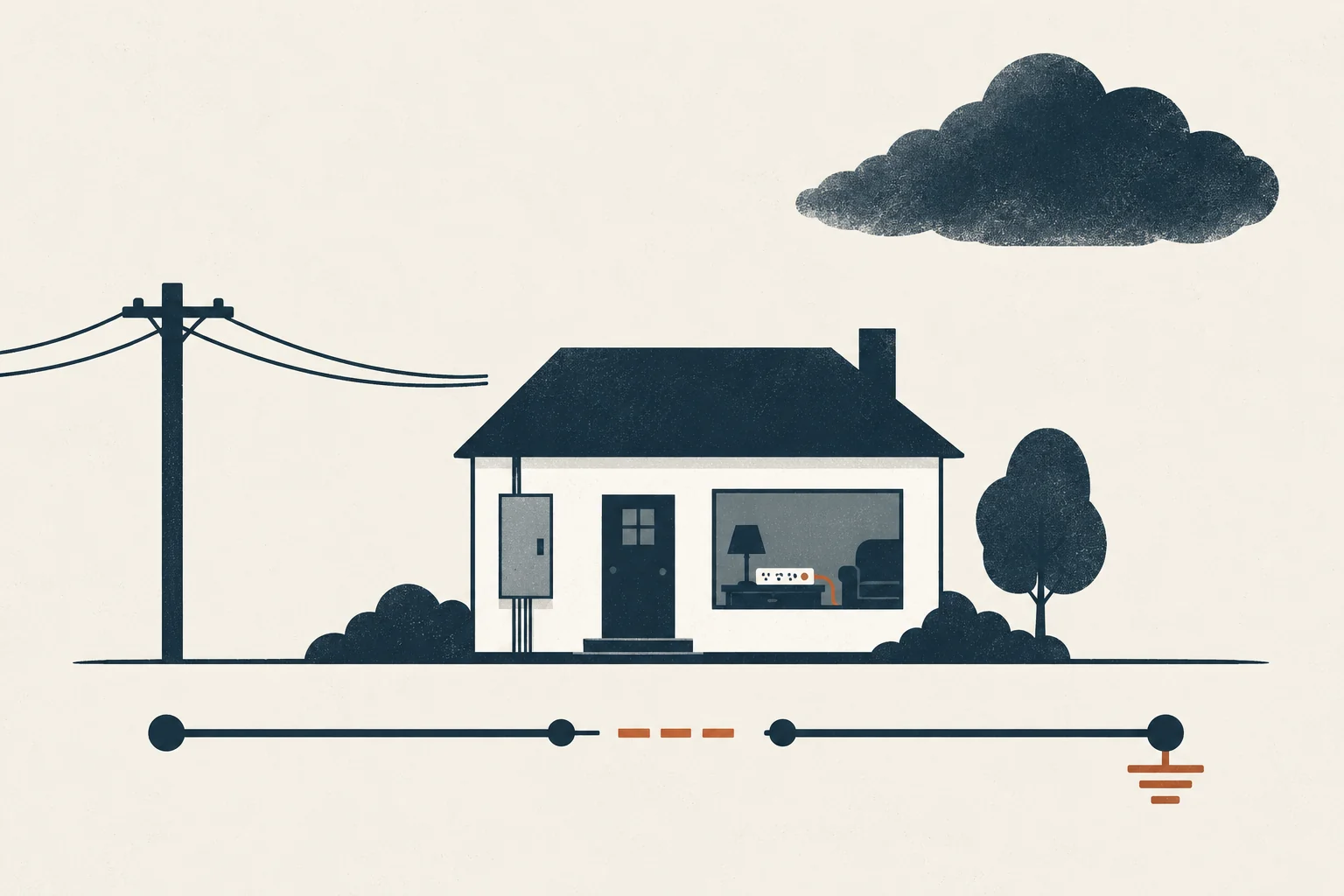
Surge protectors can limit short voltage transients associated with nearby lightning or surges entering on electrical conductors. They do not make a home lightning-proof, and an ordinary whole-home or plug-in SPD cannot guarantee equipment survival during a direct strike. A complete lightning-protection system is a separate engineered system.
The most useful plan separates three jobs: SPDs limit transients on protected conductors; grounding and bonding provide the required electrical reference/path; and a lightning-protection system intercepts and conducts lightning energy under its own design standards.
Nearby lightning versus a direct strike
Lightning can induce voltage on nearby power or communications lines, or cause utility-system disturbances that send a transient toward a home. A properly selected and installed SPD is designed to limit such transient overvoltage within its ratings.
A direct strike can involve extreme energy and multiple paths through the structure, wiring, plumbing, communications, and ground. ESFI states that no surge protector can handle a direct lightning strike. Marketing that promises otherwise should be rejected.
What a whole-home SPD contributes
A Type 1 or Type 2 SPD at the service or panel creates an upstream power layer. Its effectiveness depends on:
- correct voltage, phase, type, modes, and ratings;
- permitted location and compatible equipment;
- short, instruction-compliant connection path;
- grounding and bonding condition;
- status and remaining serviceability; and
- event path and magnitude.
It limits a transient; it does not absorb every joule of a storm or create a shield around the building.
Why plug-in protection may still matter
A listed Type 3 device near sensitive electronics can add a downstream limiting stage. It may also protect a compatible signal line when that line passes through a port designed for it.
The common gap is protecting only the AC cord while coax, antenna, Ethernet, or telephone conductors remain connected. A surge can enter or create damaging potential differences across more than one path. See whole-home vs plug-in protectors.
Grounding and bonding are not optional extras
An SPD cannot repair improper grounding or bonding. The electrical and communications systems need the grounding/bonding required for the installation. Do not add improvised rods, wires, or connections based on an online diagram; parallel or poorly coordinated paths can create hazards.
Have a qualified professional evaluate visible damage, older service work, separate grounds, or concerns identified during surge-protection planning.
What is a lightning-protection system?
A building lightning-protection system is designed to intercept a strike and conduct current to ground through a coordinated set of air terminals, conductors, bonds, grounding electrodes, and surge protection. UL identifies separate standards and certification categories for lightning-protection components and installed systems.
It is not the same as:
- a single ground rod;
- a whole-home SPD;
- a plug-in strip;
- a rooftop antenna ground; or
- a “lightning arrestor” sold without a complete design.
For high exposure, historic or high-value structures, repeated lightning concerns, or a risk assessment, consult a qualified lightning-protection specialist and insurer.
What to do during a thunderstorm
Follow National Weather Service lightning safety guidance. Go indoors when thunder is heard and remain sheltered for the recommended period after the last thunder. Avoid contact with corded electrical equipment and plumbing during the storm. Do not go outside to disconnect equipment after lightning is close.
Unplugging selected electronics can reduce conductive connections only when done well before the storm and without creating another hazard. Do not rely on last-minute unplugging as a protection plan.
After a suspected lightning surge
If you see fire, sparks, smoke, downed lines, or damaged service equipment, keep away and use emergency/utility channels. Otherwise document the time/event, check only visible SPD indicators, keep abnormal equipment out of service, and contact qualified help. Do not open the panel or discard a failed SPD before warranty/insurance guidance.
Use the full after-a-power-surge checklist.
A practical lightning-related protection path
- Maintain compliant electrical and communications grounding/bonding.
- Install a compatible Type 1 or Type 2 whole-home SPD professionally.
- Add appropriate Type 3 and signal-path protection for important equipment.
- Keep indicators visible and records current.
- Consider a separately designed lightning-protection system when risk justifies it.
- Follow storm-safety guidance; property protection never outranks personal safety.
Claims to avoid
- “This device stops lightning.”
- “A 140 kA label means it survives a direct strike.”
- “One panel SPD protects coax, Ethernet, antenna, and phone lines automatically.”
- “A lightning-protection system makes SPDs unnecessary.”
- “A green light proves there was no equipment damage.”
Bottom line
SPDs are valuable for lightning-related transients, especially as coordinated power and point-of-use layers. They are not a guarantee against direct-strike damage. Treat direct lightning, grounding/bonding, surge protection, and building lightning protection as connected but distinct engineering problems.
Sources
- Electrical Safety Foundation International — Surge Protection
- National Weather Service — Lightning Safety
- UL Solutions — Lightning Protection Application Guide
- NIST — Surges Happen
This guide does not replace a site-specific lightning risk assessment or engineered system.