
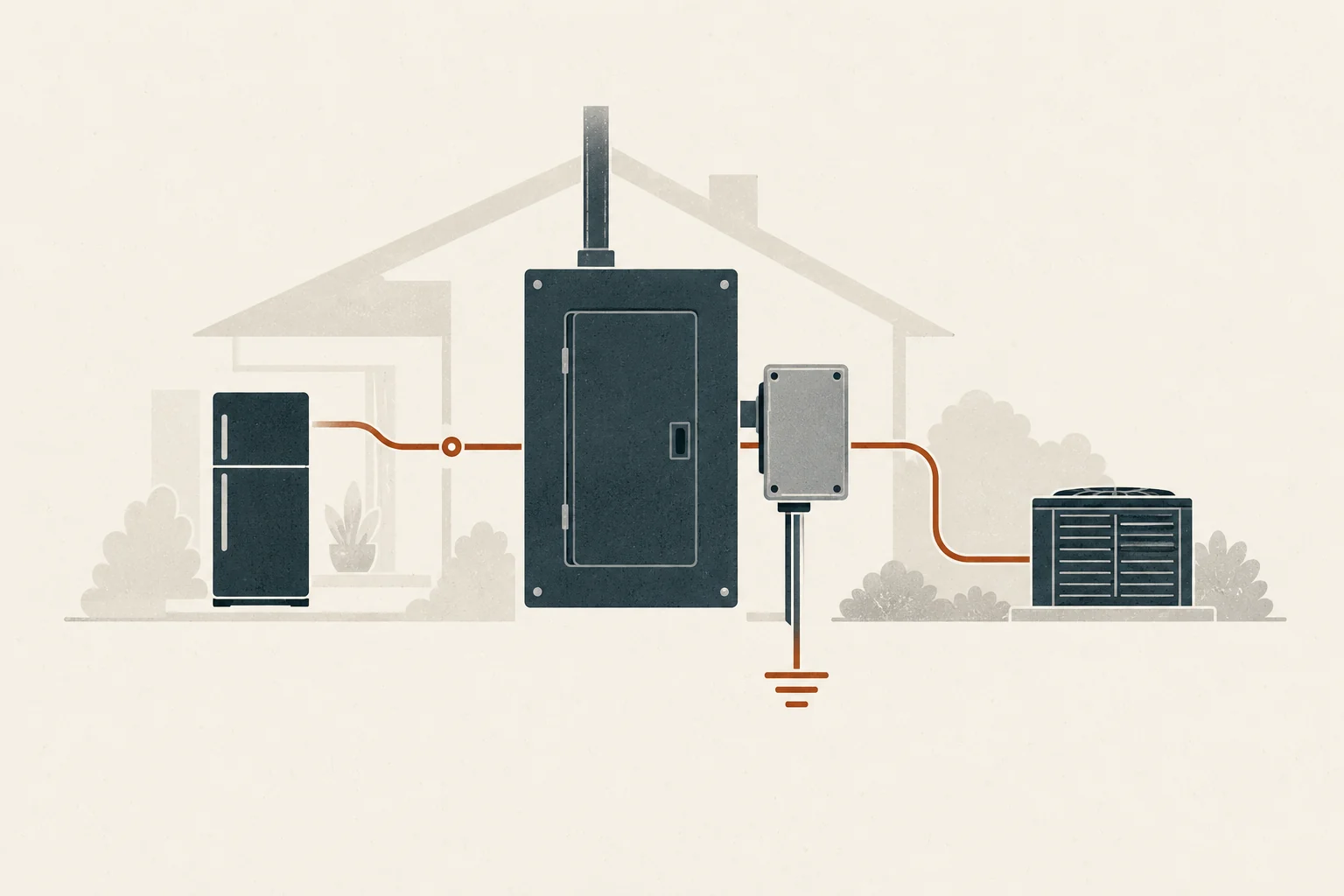
Whole-home surge protection uses a surge protective device, or SPD, at or near a home’s electrical service or main panel to limit short bursts of excess voltage before they travel farther through the wiring. It is the first layer in a practical protection plan—not an invisible shield around every appliance and not a substitute for point-of-use protection, grounding, maintenance, or safe electrical work.
This guide explains what the device does, how the protection layers fit together, what the common ratings mean, and what to ask before installation.
Safety boundary: Whole-home SPDs connect to service or panel equipment that can contain hazardous energy even when some breakers are off. Product selection and hardwired installation belong with a qualified electrician following the manufacturer’s instructions and the locally adopted electrical code.
What whole-home surge protection does
A voltage surge is a brief increase above the normal voltage on an electrical circuit. Surges can enter from outside the house, but they can also arise when motors and other loads switch inside a building. The Electrical Safety Foundation International describes whole-home and point-of-use devices as complementary protection and recommends qualified installation for whole-home equipment.
An SPD provides a controlled path for transient energy when voltage rises above the device’s operating threshold. In ordinary conditions it largely stays out of the circuit. During a qualifying transient, its protective components conduct and limit the voltage passed downstream. That action happens quickly, but it does not make the incoming event disappear or hold household voltage at one perfect value.
The useful homeowner translation is simple: a correctly selected and installed whole-home SPD can reduce the stress that short voltage spikes place on electronics throughout the house. Its performance depends on the electrical system, installation location, conductor length and routing, device condition, and the size and character of the event.
How a panel-mounted surge protector works
Most residential products connect at the service equipment or distribution panel. Some are separate enclosures mounted beside the panel; others are designed for a compatible breaker position or integrated into equipment. The physical shape is less important than electrical compatibility and the device’s documented ratings.
When comparing options, an electrician should confirm at least:
- the home’s voltage and phase configuration;
- whether the device is listed and marked for the intended Type 1 or Type 2 location;
- how the product connects to the specific equipment;
- voltage protection rating, nominal discharge current, surge-current rating, short-circuit current rating, protection modes, and maximum continuous operating voltage;
- indoor or outdoor enclosure requirements;
- lead length and placement allowed by the instructions;
- status lights, alarms, remote contacts, or replaceable-module behavior; and
- product and connected-equipment warranty terms, including registration and installation conditions.
Those fields describe different things. A larger kA number alone does not prove that one unit is the better fit. Our whole-house surge protector ratings guide translates the specification sheet without turning it into a one-number contest.
The three layers of a home protection plan
Surge protection works best as a coordinated path rather than a single purchase.
Service-side or Type 1 protection
A Type 1 SPD is investigated for installation between the utility transformer and the service disconnect, including locations permitted on the load side. The exact allowed location comes from the product listing, instructions, equipment, and local code.
Panel-side or Type 2 protection
A Type 2 SPD is installed on the load side of the service disconnect, commonly at a distribution panel. This is a familiar whole-home arrangement, but “Type 2” does not automatically mean universal fit or lower quality.
Point-of-use or Type 3 protection
Type 3 devices serve loads farther downstream. Examples include listed plug-in strips and surge-protective receptacles. They can add protection close to sensitive electronics and may also cover signal lines when the product is designed for them.
The types describe evaluated installation locations and uses—not gold, silver, and bronze quality levels. See Type 1 vs Type 2 vs Type 3 surge protectors for the full comparison and whole-home vs plug-in surge protectors for practical layering examples.
What surge protection cannot do
Good planning starts with honest limits.
- It cannot guarantee that equipment will survive every event. Event energy, paths into the home, installation, and equipment susceptibility vary.
- It is not a voltage regulator. A transient SPD is not designed to correct every sustained overvoltage, undervoltage, outage, frequency problem, or poor power-quality condition.
- It does not replace grounding and bonding. The electrical system still needs compliant grounding and bonding; an SPD cannot repair a deficient installation.
- It does not protect every communications path automatically. Power, coaxial, telephone, network, antenna, and other conductors may require their own coordinated protection.
- It is not a complete direct-lightning solution. ESFI warns that no surge protector can handle a direct lightning strike. A lightning-protection system is a separate engineered subject. Our guide to surge protectors and lightning explains that boundary.
- It is not permanent without inspection. Protective components absorb stress over time. Status indication and replacement guidance differ by manufacturer.
Avoid claims such as “blocks all surges,” “protects everything,” or “lasts forever.” They are not useful selection criteria.
Is whole-home surge protection worth it?
There is no single dollar formula for every house. The decision is stronger when the home contains expensive electronically controlled equipment, experiences frequent storms or utility disturbances, has a home office or medical/communications dependency, or is already undergoing electrical-service work.
The tradeoffs are real too. The product and labor cost money; panel space and placement may complicate the job; warranties have conditions; and a device still needs periodic status checks. A calm assessment compares those costs with the number and importance of connected loads—not with a fear-based estimate of everything that might fail.
Use our signs and tradeoffs guide if you are still deciding. If the decision is already made, move to how to choose a whole-house surge protector.
What installation normally involves
A proper job begins with the electrical system, not the product box. The electrician evaluates the service and panel, confirms the voltage configuration and equipment fit, chooses an allowed mounting location, follows the connection and overcurrent-protection instructions, and verifies the device’s status after energizing.
Placement matters because unnecessary conductor length and poor routing can reduce how effectively an SPD limits a fast transient. That is one reason a product with impressive catalog numbers can perform poorly in an unsuitable installation.
Homeowners can prepare without opening anything:
- Photograph the outside of the panel and its label only if it is safely accessible.
- Note whether the panel is indoors or outdoors and whether spaces appear available; let the electrician verify the interior.
- List other service work, generators, solar, EV charging, or major HVAC equipment that may affect the discussion.
- Ask for the exact model, installation location, permit/inspection scope, warranty steps, and status-check instructions in the quote.
- Keep the invoice, product information, and final photos after the work.
Read what to expect during installation and the whole-house surge protector cost guide before comparing quotes.
How to choose and maintain the system
Start with compatibility, then compare performance and ownership details. A useful shortlist answers five questions:
- Is the device listed and intended for this location and electrical system?
- Do its VPR, nominal discharge current, modes, SCCR, MCOV, and enclosure match the application?
- Can it be installed with a short, manufacturer-compliant connection path?
- How does it show normal, degraded, or end-of-life status?
- What actions keep the warranty and connected-equipment coverage valid?
After installation, look at the external status indication on the schedule in the instructions and after a known electrical event. Do not remove the cover or treat a light as proof that every connected device is safe. If the indicator changes, an alarm sounds, the enclosure is damaged, or you are unsure what the state means, use the manufacturer’s guidance and contact a qualified electrician.
Our maintenance and status-check guide covers the homeowner-safe checks.
A practical next step
Whole-home surge protection is most useful when it is treated as a system: correct product, correct location, professional installation, point-of-use layers where they add value, and a simple inspection record.
If you want to compare devices, start with the compatibility-first whole-house surge protector comparison. If you want professional help, prepare your panel information and use the electrician questions in this guide before requesting a quote.
Sources and methodology
- Electrical Safety Foundation International — Surge Protection
- NEMA US 80016-2022 — Surge Protective Devices and NEC 230.67
- NIST — Surges Happen
- Leviton — Whole Home Surge Protection
- Eaton — Complete Home Surge Protection
This article synthesizes safety-organization, standards-industry, government, and manufacturer material for homeowners. It does not replace product instructions, an electrical inspection, the locally adopted code, or professional advice for a specific installation.