
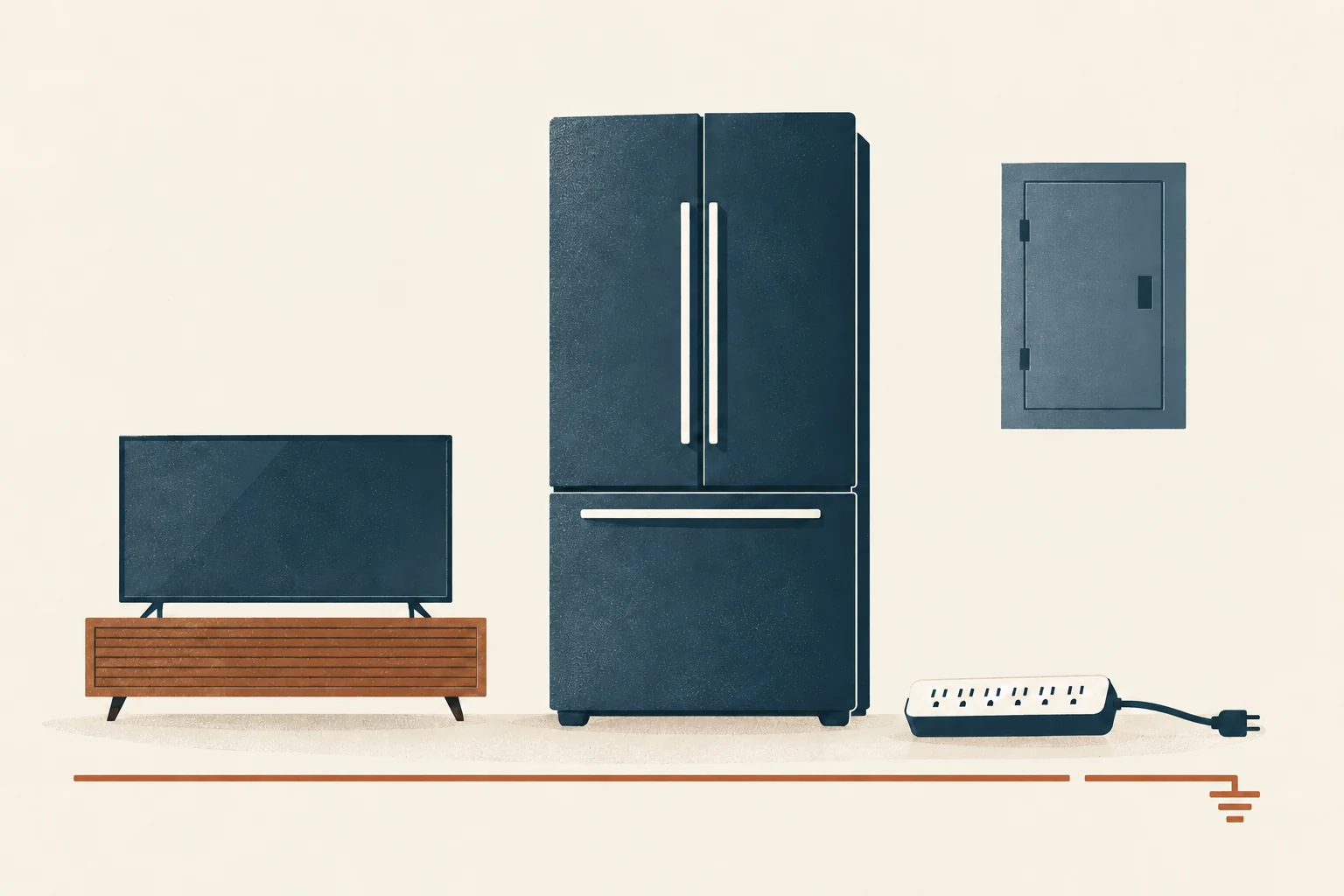
The safest broad strategy for appliance surge protection starts with a compatible whole-home Type 1 or Type 2 SPD, then adds point-of-use protection only where the appliance instructions, load, outlet, and product listing permit it. Do not put refrigerators, freezers, washers, dryers, ranges, dishwashers, room air conditioners, or other high-load appliances on an ordinary extension-style surge strip unless both manufacturers explicitly allow that exact use.
Modern appliances often contain electronic controls even when their main job is mechanical or thermal. An upstream whole-home layer helps cover hardwired and large loads that cannot use a typical plug-in protector.
Affiliate disclosure: Surge Protection Experts may eventually earn compensation from qualifying product links. No affiliate link is active in this draft. Select devices by certification, electrical fit, instructions, and protection role—not commission.
The three-part appliance plan
- Upstream layer: a professionally selected Type 1 or Type 2 SPD at service/distribution equipment.
- Equipment layer: a listed Type 3 receptacle or plug-in device only where it suits the appliance and circuit.
- Other paths and power problems: separate protection or monitoring for signal lines, HVAC controls, sustained voltage events, or outages when justified.
An SPD limits short transients. It is not a voltage regulator, uninterruptible power supply, generator, or complete lightning-protection system.
Whole-home protection is the foundation
A panel/service SPD provides a common upstream stage for many circuits. That matters for appliances that are hardwired, use dedicated high-current circuits, or are installed where a consumer strip is unsuitable.
It can help cover:
- refrigerators and freezers;
- washers and gas-dryer controls;
- electric dryers, ranges, ovens, and cooktops through their circuits;
- dishwashers and disposals;
- furnaces, air handlers, heat pumps, and condensers;
- smart lighting and controls; and
- plugged electronics throughout the home.
“Cover” means the device forms part of the power-path protection. It does not guarantee every load or address all communications/control conductors. The exact whole-home product must match the system and be installed by a qualified electrician.
Refrigerators and freezers
Refrigerators combine compressors, relays, inverters, sensors, displays, and control boards. Their continuous operation makes both protection and safe power delivery important.
Start with the whole-home layer. Before adding a point-of-use product:
- read the refrigerator/freezer manual;
- confirm the branch circuit and plug/receptacle rating;
- avoid ordinary extension cords and multi-outlet strips;
- use only a device specifically listed and suitable for the load/application; and
- keep the device’s status visible rather than trapped behind the appliance forever.
A qualified electrician may recommend a listed surge-protective receptacle when appropriate. A receptacle is fixed wiring and requires professional installation; it is not a consumer adapter shortcut.
Washers and dryers
Electronic washers and dryers can contain sensitive control boards alongside motors and heaters. The upstream SPD is the broad layer.
Do not put an electric dryer on a common 120 V surge strip. Its circuit, receptacle, and load are fundamentally different. For a gas dryer or washer using a standard receptacle, follow the appliance instructions and use only a product listed for the circuit and load if a downstream layer is recommended.
Also remember that water, vibration, and inaccessible locations affect device selection and inspection. Never use an indoor extension-style product in a damp or prohibited environment.
Ranges, ovens, dishwashers, and disposals
Many cooking and kitchen appliances are hardwired or use dedicated circuits. A panel/service SPD is the practical first layer. A plug-in strip is generally not an appropriate add-on for a range, wall oven, dishwasher, or disposal.
If an appliance manufacturer offers or requires a specific protective accessory, have the installer confirm that it is compatible with the circuit and does not conflict with listing or warranty terms.
HVAC equipment
Air conditioners and heat pumps often justify a separate equipment-side SPD in addition to the whole-home layer. Outdoor placement, disconnect arrangement, voltage/phase, SCCR, modes, enclosure, status, and HVAC instructions all matter.
Transient protection should also be distinguished from undervoltage/overvoltage monitoring and short-cycle delay. A combination product may provide more functions, but each must fit the equipment.
See our HVAC surge protector comparison for current AG3000 and ICM517A candidates and installation questions.
Televisions, computers, and networking equipment
These are the most natural point-of-use candidates. Use a certified surge protector—not a basic power strip—and keep within its load rating. Consider every conductive path:
- AC power;
- coaxial cable;
- Ethernet;
- telephone/DSL;
- antenna; and
- connections between devices in the same system.
A protector covers only paths routed through inputs designed for them. Use signal protectors compatible with the service and bandwidth; do not improvise grounding or adapters.
For equipment that needs orderly shutdown during outages, a suitable UPS may add battery backup. Its surge function and battery function should be evaluated separately.
What a Type 3 receptacle can do
A surge-protective receptacle provides a fixed point-of-use layer. As a current example, Leviton’s 5480-W is a Type 3, 15 A, 125 V, four-outlet receptacle with an indicator light, 3 kA In, and published VPR values. It is an example of the form—not a universal recommendation for appliances.
Before selecting any wired receptacle, the electrician should confirm:
- circuit voltage and amperage;
- appliance plug/load compatibility;
- box space, grounding, and location;
- line/load behavior described by the manufacturer;
- status visibility and replacement plan; and
- locally adopted electrical requirements.
Do not install it from an article; use the current instruction sheet and qualified electrical work.
Why ordinary surge strips can be the wrong tool
Extension-style products are frequently hidden, overloaded, daisy-chained, pinched behind appliances, exposed to heat/moisture, or used with loads the instructions prohibit. Those are safety problems independent of surge performance.
Never assume that a higher joule number makes a strip appropriate for a refrigerator, washer, heater, air conditioner, microwave, or other large load. The outlet/load rating and manufacturer instructions come first.
UL’s consumer guidance also warns that an ordinary power strip is not automatically a surge protector. Look for certification and explicit surge-protection markings.
How to prioritize appliances
Use a calm risk-and-impact screen:
- Replacement and repair cost: expensive control boards and integrated systems may justify more attention.
- Consequence of downtime: refrigeration, medical support, communications, and climate control may matter more than convenience loads.
- Available protection path: hardwired/high-load equipment depends more on upstream or professionally fitted protection.
- Other conductors: networked or signal-connected equipment may need coordinated paths.
- Status visibility: a hidden device that is never checked can fail silently.
- Manufacturer guidance: explicit requirements outweigh generic internet advice.
The aim is not to attach a gadget to every appliance. It is to close the largest credible gaps safely.
What appliance surge protection cannot solve
- sustained high or low voltage;
- outages or loss of refrigeration time;
- frequency or waveform problems;
- damaged branch-circuit wiring;
- poor grounding/bonding;
- every direct-lightning effect;
- a surge arriving on an unprotected signal path; or
- normal appliance component failure.
If the symptom is repeated dimming, sustained abnormal voltage, burning odor, heat, buzzing, tripping, or equipment malfunction, stop treating it as a surge-accessory shopping question and contact the appropriate utility, electrician, or appliance/HVAC professional.
Homeowner checklist
- Confirm whether a compatible whole-home SPD is installed and showing normal status.
- List high-value/critical appliances and every conductor connected to them.
- Read each appliance’s power and accessory instructions.
- Eliminate overloaded, damaged, daisy-chained, or prohibited strips.
- Ask a qualified electrician about fixed Type 3 or HVAC-side layers where justified.
- Record model, purchase/installation date, status meaning, and replacement action.
- Recheck visible indicators after known electrical events and on the manufacturer’s schedule.
Use whole-home vs plug-in surge protectors for a direct layer comparison and how to check a whole-home SPD for routine ownership.
For computers, televisions, networking, and smart-home systems with multiple power and signal paths, use the separate whole-home surge protection guide for electronics.
Sources and methodology
- UL Solutions — Guide to Power Strips and Surge Protectors
- Leviton — 5480-W Type 3 surge-protective receptacle
- Leviton — current surge-protective receptacle instructions
- Electrical Safety Foundation International — Surge Protection
- NIST — Surges Happen
This guide uses representative categories rather than inventing a separate thin page for every appliance. Exact product and appliance instructions control the application.