
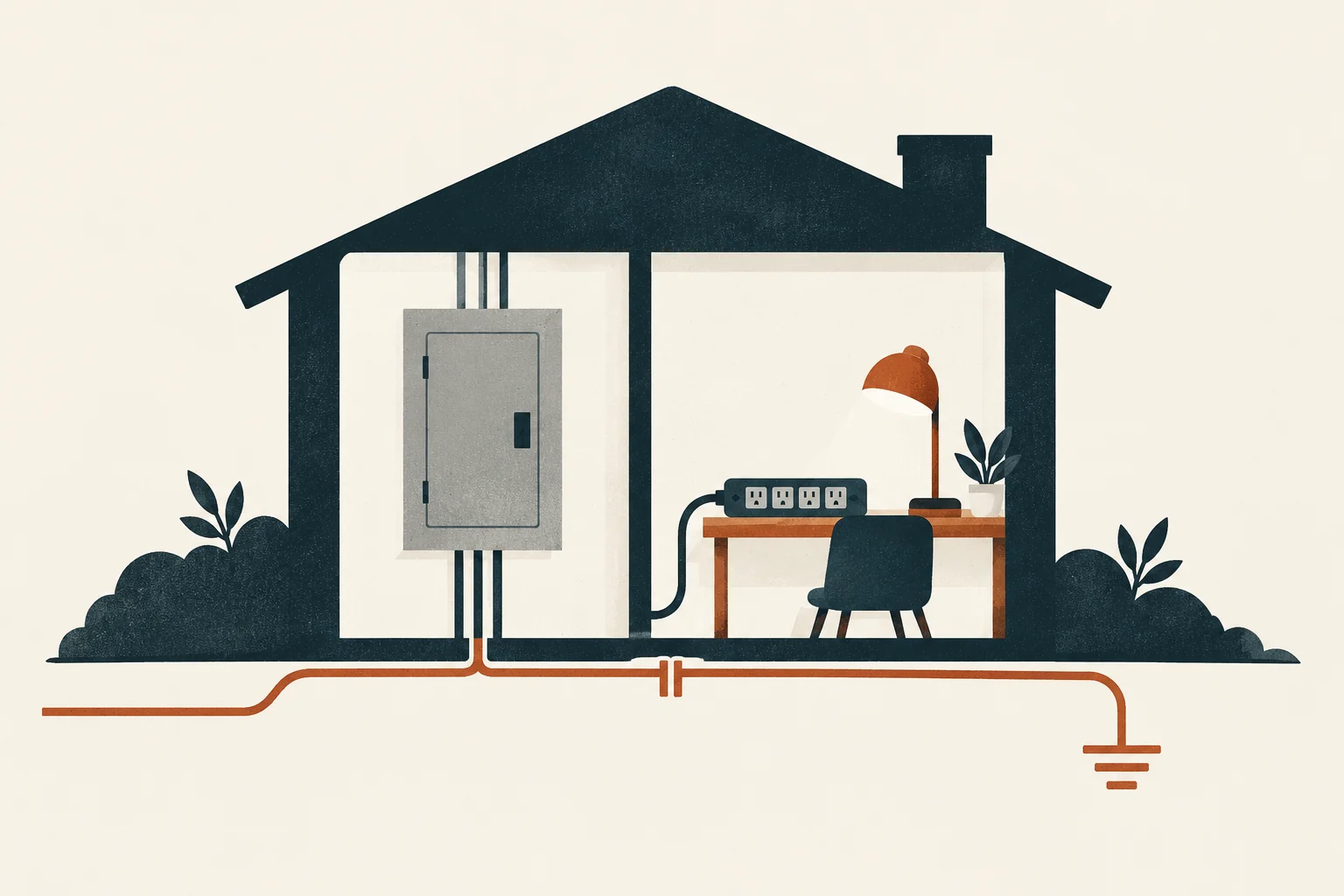
Whole-home and plug-in surge protectors are not competing versions of the same product. A Type 1 or Type 2 device at the service or panel limits transients for the home’s distribution system; a Type 3 plug-in or receptacle device adds a stage near selected equipment. For sensitive electronics, using both can provide a more complete protection path than relying on either alone.
Neither layer guarantees that equipment will survive every event. The result depends on the electrical system, grounding and bonding, device listing and ratings, installation, other conductive paths, and the event itself.
Affiliate disclosure: Surge Protection Experts may eventually earn compensation from qualifying product links. No affiliate link is active in this draft. Product selection should start with listing, load, and application—not price or commission.
At-a-glance comparison
| Question | Whole-home Type 1/2 layer | Plug-in or receptacle Type 3 layer |
|---|---|---|
| Where is it? | Service or distribution equipment | Near the protected load |
| What can it serve? | Many circuits and hardwired/plugged loads downstream | Equipment connected to that device; nearby coverage only as documented |
| Who installs it? | Qualified electrician | Plug-in products are consumer-connected; wired receptacles require qualified electrical work |
| Can it protect signal lines? | Only if a separate/combined product is designed for them | Some models include coax/phone/network paths; only connected lines are addressed |
| Does it need status checks? | Yes | Yes |
| Does one replace the other? | No | No |
What a whole-home SPD covers
A whole-home SPD is placed at or near service/distribution equipment. Its early position lets it limit a transient before the event travels farther through the branch circuits. It can add protection for loads that cannot reasonably plug into a strip, including lighting and many major appliances.
Its advantages include:
- broad distribution-system coverage;
- one upstream layer for many circuits;
- protection for hardwired and large loads; and
- a coordinated first stage before point-of-use devices.
Its limits include:
- no automatic coverage of communications or antenna conductors;
- distance and wiring effects between the panel and far-away loads;
- a need for professional selection and installation; and
- no guarantee against every surge, sustained voltage problem, or direct lightning strike.
Read what whole-home surge protection does for the full system explanation.
What a plug-in surge protector covers
A listed Type 3 plug-in protector operates close to the utilization point. It can provide an additional limiting stage for computers, televisions, networking equipment, and other loads that its electrical rating and instructions allow.
Some models provide multiple outlets, status lights, filtering, automatic shutdown, or protection for signal lines. Those features are model-specific. A coax port printed on the package does nothing if the relevant line bypasses it.
Type 3 advantages include:
- local protection close to selected electronics;
- easy replacement and visible status on many models;
- options for power plus specific signal paths; and
- accessibility for renters who cannot modify service equipment.
Limits include:
- coverage only for connected loads/paths;
- unsafe use if overloaded, daisy-chained, damaged, or used contrary to instructions;
- no protection for hardwired appliances elsewhere; and
- confusion between basic power strips and actual surge protectors.
UL advises consumers to confirm that a product is a certified surge protector rather than an ordinary multi-outlet power strip.
Do you still need surge strips with a whole-home protector?
Often, yes—selectively. Point-of-use protection can add value for sensitive electronics, long branch circuits, home-office or entertainment systems, and equipment with a separate conductive data path. It is not necessary to put every lamp or simple load on a premium strip.
Prioritize devices where:
- replacement cost or data importance is high;
- several related electronics connect together;
- signal cables enter the equipment group;
- the equipment instructions recommend surge protection; or
- interruption would be especially disruptive.
The right point-of-use product must also suit the load. Do not connect high-load appliances, heaters, air conditioners, or equipment prohibited by the device instructions to an extension-style strip.
Is a plug-in protector enough without whole-home protection?
A plug-in device is better than an ordinary strip for the equipment connected to it, but it is not a substitute for an upstream layer. It cannot protect lighting, hardwired controls, appliances, or outlets elsewhere. It also handles only the paths routed through it.
For renters, a plug-in layer may be the only controllable option. Use listed products correctly, ask the property owner about building-level protection, and avoid modifying fixed wiring.
Power strips are not all surge protectors
A basic relocatable power tap adds outlets. A surge protective device includes evaluated transient-limiting components and markings. Packaging language can be confusing, so check:
- certification/listing for the intended use;
- explicit surge-protective function;
- Type 3 or applicable product information;
- electrical load and outlet rating;
- status or end-of-life behavior;
- VPR and other published surge fields;
- cord length and placement instructions; and
- prohibition on daisy chaining or damp/outdoor use.
A joule number is not a complete selection method. It does not replace certification, VPR, load fit, status behavior, or safe use.
What about surge-protective receptacles?
A wired Type 3 receptacle can add protection without an extension cord. For example, Leviton lists its 5480-W as a Type 3, 15 A, 125 V surge-protective receptacle with an indicator light and published VPR. It requires electrical installation and remains a point-of-use layer—not a whole-home replacement.
This form may suit a fixed electronics location where a qualified electrician confirms the circuit and device. It still needs a status-check and replacement plan.
Signal lines are part of the decision
Ethernet, coaxial cable, telephone, antenna, and other conductors can create paths that a power-only SPD does not cover. Protecting the power cord while leaving another exposed conductor connected can leave a gap.
Use only devices designed and listed for the relevant signal, bandwidth, grounding arrangement, and application. Improvised adapters or grounding connections can create new hazards or performance problems.
A practical layered plan
- Have an electrician assess a compatible Type 1 or Type 2 whole-home layer.
- Identify the most sensitive or important equipment groups.
- Map every conductive path into those groups, not just the outlet.
- Select certified Type 3 devices suited to the connected load and signal lines.
- Keep both upstream and point-of-use indicators visible.
- Record installation/purchase dates and replace devices when their instructions or status require it.
For product fields, see how to choose a whole-house surge protector. For appliance-specific examples, see surge protection for home appliances.
Common mistakes
- Treating a cheap multi-outlet strip as a certified surge protector.
- Daisy-chaining power strips or using them with prohibited high-load equipment.
- Assuming a panel SPD covers every communications path.
- Hiding a failed-status light behind furniture indefinitely.
- Buying by joules or kA alone.
- Believing any layer guarantees protection from a direct lightning strike.
- Opening a panel to turn whole-home selection into a DIY project.
Bottom line
Whole-home and plug-in surge protectors solve different parts of the same problem. Use the whole-home device as the upstream power layer and certified Type 3 protection where local electronics or signal paths justify it. The strongest plan is coordinated, visible, maintainable, and matched to the actual equipment—not a house full of random strips.
Sources and methodology
- UL Solutions — Guide to Power Strips and Surge Protectors
- UL Solutions — Panelboard Application Guide
- Electrical Safety Foundation International — Surge Protection
- Leviton — 5480-W Type 3 surge-protective receptacle
- NIST — Surges Happen
This article addresses transient surge protection, not sustained voltage regulation, backup power, or a complete lightning-protection system.