
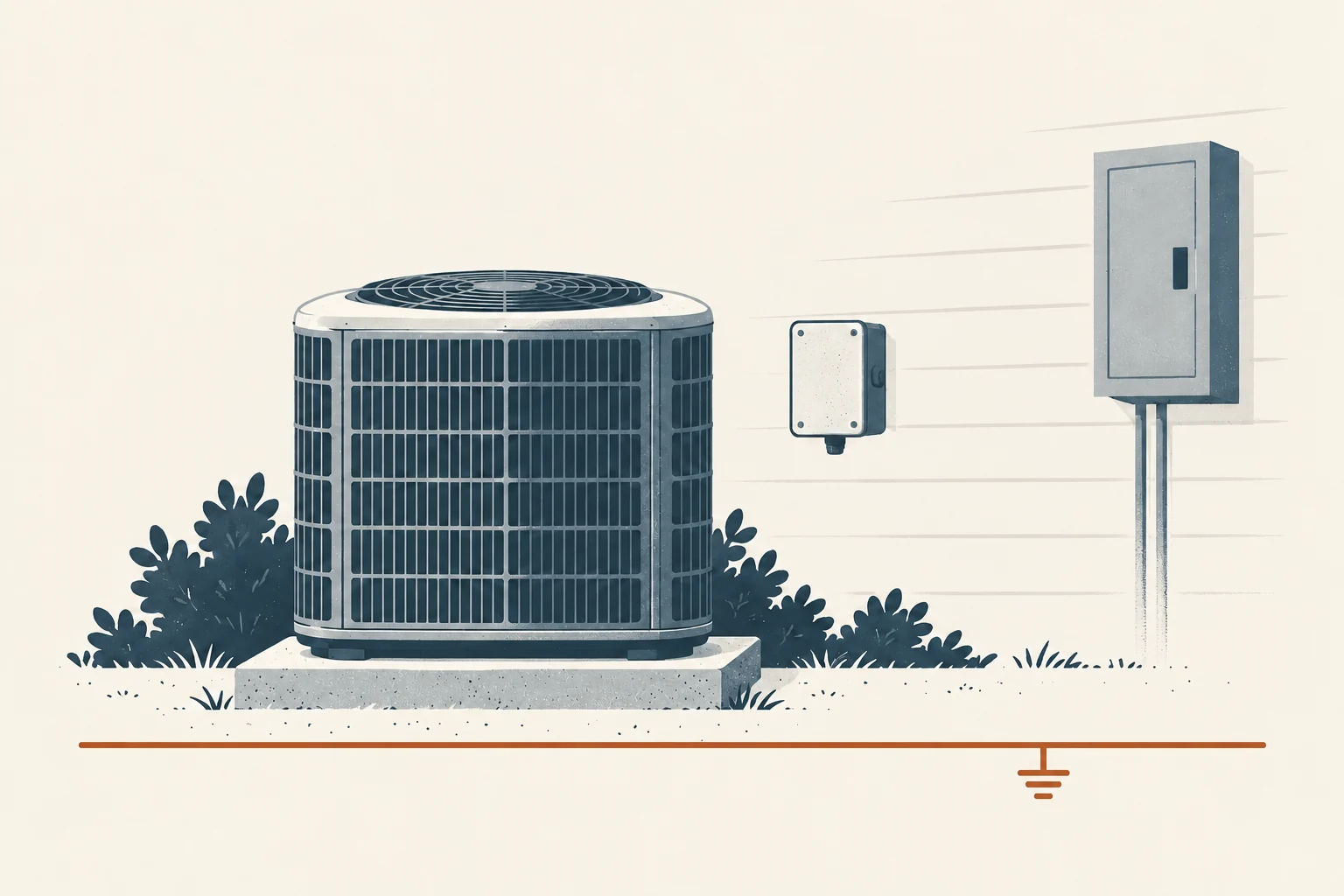
For a typical 120/240 V single-phase residential air conditioner or heat pump, the Intermatic AG3000 and ICM Controls ICM517A are two current equipment-side surge protectors worth investigating. The AG3000 publishes a stronger standardized 20 kA nominal discharge current and clearer full rating set; the ICM517A emphasizes a rugged cast-aluminum NEMA 4X enclosure, 100 kA maximum surge-current figure, and updated product warranty.
Neither is automatically right for a specific unit. HVAC voltage, phase, disconnect arrangement, available fault current, enclosure exposure, modes, instructions, and installer approval decide the fit. Equipment-side protection can also complement—not replace—a whole-home service or panel SPD.
Affiliate disclosure: Surge Protection Experts may eventually earn compensation from qualifying purchases. No affiliate program is active in this draft, and current product links go to manufacturer sources. We do not rank by commission or claim hands-on testing.
Quick comparison
| Product | Best fit to investigate | Type / voltage | Key published ratings | Enclosure / status | Warranty headline |
|---|---|---|---|---|---|
| Intermatic AG3000 | Homeowner who wants a well-documented HVAC-focused SPD with 20 kA In | Type 1 or 2; 120/240 V single-phase | 20 kA In; 50 kA per phase; 100 kA SCCR; 700 V L-N, 1,200 V L-L VPR | Type 4X; green normal/red diminished LEDs | 3-year product; 3-year/$7,500 connected-equipment |
| ICM517A | Outdoor application where robust cast-aluminum construction and all listed AC modes are priorities | Type 2; 120/240 V single-phase | 100,000 A max surge current; L-L, L-N, L-G, N-G modes; verify full current datasheet with installer | NEMA 4X; green status light | Limited lifetime product; up to 3-year/$25,000 connected-equipment |
Warranty headlines are not promises of claim payment. Read registration, installation, covered-equipment, event, proof, and deadline terms.
Intermatic AG3000: strongest documented comparison baseline
The Intermatic AG3000 is marketed for distribution panels, HVAC equipment, and service-entrance applications. Intermatic lists it for Type 1 or Type 2 use at 120/240 V single phase, subject to its instructions.
Reasons to consider it
- 20 kA nominal discharge current;
- 100 kA short-circuit current rating;
- 50 kA maximum surge current per phase;
- three published modes: L1-N, L2-N, and L1-L2;
- 700 V L-N and 1,200 V L-L VPR;
- Type 4X outdoor enclosure; and
- separate green and red status states.
Limits to understand
The three modes do not include every conductor-pair mode that appears on some other SPDs. The connected-equipment limit is modest compared with some whole-home products, and all warranty conditions still apply. A red “protection diminished” state means the owner needs a response plan; the product is not a lifetime set-and-forget purchase.
ICM517A: rugged current successor to the ICM517
The ICM517A is the current update to ICM’s older ICM517. ICM describes it as a Type 2 SPD for 120/240 V single-phase equipment, using a powder-coated cast-aluminum NEMA 4X enclosure.
Reasons to consider it
- current successor rather than the legacy ICM517 page;
- all published AC protection modes: L-L, L-N, L-G, and N-G;
- 100,000 A maximum surge-current claim;
- compact outdoor-rated enclosure; and
- green protection-status indicator.
Limits to understand
The current public product page does not expose every standardized field in the same detail as Intermatic’s AG3000 page. Before selection, obtain the current datasheet/instructions and confirm In, VPR, MCOV, SCCR, connection requirements, and warranty conditions for the exact ICM517A—not the obsolete ICM517. A larger maximum surge-current label alone is not enough to rank it above the AG3000.
Whole-home SPD versus HVAC-side SPD
A whole-home SPD is positioned at service or distribution equipment to limit transients for many downstream circuits. An HVAC-side device is positioned near the equipment or disconnect as allowed, adding another limiting stage close to the condensing unit.
They have overlapping but not identical jobs:
- Whole-home layer: broader power-distribution coverage for appliances, controls, and circuits.
- HVAC-side layer: additional local stage for an expensive outdoor load, with status visible near the equipment.
- Signal/control paths: may require separately designed protection; a line-voltage SPD does not automatically protect thermostat or communications conductors.
An equipment-side product does not correct poor grounding, sustained overvoltage, undervoltage, phase problems, rapid cycling, or every utility issue. Some combination products add voltage monitoring or time-delay functions, but those features must be evaluated separately from transient surge protection.
Do you need both layers?
Both may be reasonable when the HVAC system is high-value, electronically controlled, far downstream, exposed outdoors, or important to the occupants. The decision should consider the existing whole-home layer, equipment instructions, local exposure, installer assessment, and cost.
Avoid duplicate spending without a plan. Ask the electrician or HVAC professional to sketch which conductor paths each device addresses and what remains uncovered.
Ratings that matter for an HVAC protector
Voltage and phase
The device must match the equipment circuit. Residential condensers are not universally 240 V single-phase, and light-commercial equipment may differ.
SPD type and installation point
Type 1 and Type 2 markings determine permitted placement. “Made for HVAC” is marketing context, not permission to connect anywhere.
Nominal discharge current and VPR
In describes a standardized duty-cycle test level. VPR provides a standardized limiting-voltage marking by mode. These are more informative across products than a maximum-amps headline alone.
SCCR
The short-circuit current rating must suit the available fault-current application. It is not the same number as surge-current capacity.
Modes
Check whether the device protects L-L, L-N, L-G, and N-G or a subset appropriate to the application. Never infer modes from the number of status lights.
Enclosure and temperature
Outdoor equipment needs a suitable installed enclosure and environmental range. A NEMA 4X product still must be installed in the orientation and manner its instructions require.
Cost and quote factors
The device price is only one component. Installed cost varies with:
- exact model and seller;
- electrical or HVAC contractor service call;
- disconnect and equipment arrangement;
- mounting and environmental requirements;
- permit/inspection rules;
- coordination with maintenance or replacement work; and
- any separately approved repair.
Ask for the SPD as a named line item. A quote should show the exact model, location, labor, permit treatment, status demonstration, warranty paperwork, and exclusions. Do not accept “surge protector included” with no model.
Installation questions for the contractor
- Does this exact SPD match the equipment voltage and phase?
- Is its Type 1/Type 2 marking appropriate at the proposed point?
- Is the SCCR suitable here?
- Which power and control conductors does it protect or not protect?
- Will the installed enclosure remain compliant and visible?
- What do the normal, diminished, and failed indicators look like?
- Does the HVAC manufacturer impose any accessory or warranty requirements?
- What permit or inspection applies?
- Who registers the SPD warranty, and what records will I receive?
Hardwired installation is professional work. Do not remove the disconnect or equipment covers to verify a connection yourself.
When voltage monitoring may matter
A transient SPD is not a general power-quality controller. If the concern includes sustained high/low voltage, brownouts, contactor chatter, or rapid restart, ask about a listed monitoring or combination device suited to the equipment. Evaluate its voltage thresholds, delay behavior, load/contact ratings, failure mode, and HVAC-manufacturer implications separately.
Do not assume “surge + voltage protection” is better unless both functions fit the system.
Our conclusion
The AG3000 is the easier documentation-first recommendation because Intermatic publishes a complete standardized rating set, 20 kA In, clear two-color status, and Type 4X enclosure. The ICM517A is a credible current alternative when its rugged enclosure, modes, and warranty are attractive—provided the installer reviews the full current datasheet and application ratings.
For the upstream layer, compare our best whole-house surge protectors. For quote planning, use the whole-home surge protection cost guide.
Sources and update policy
- Intermatic — AG3000 current product page
- ICM Controls — ICM517A current product page
- ICM Controls — ICM517 legacy page identifying ICM517A as successor
- NEMA — Surge Protective Devices and NEC 230.67
Specifications and lifecycle status were reviewed October 17, 2026. Recheck the exact current product page, datasheet, instructions, warranty, and HVAC equipment requirements immediately before publication or purchase.